
How to read a Japanese auction sheet
The auction sheet is the only description of the car you get before you bid. It is written in shorthand by an inspector who spent a few minutes with the car. Learn to read it and you will avoid most bad buys.
Sheets are not all the same
Every Japanese auction house has its own form. USS, TAA, HAA Kobe, JU, CAA, ARAI, LAA and the smaller houses place the grade, the map and the notes in different corners, use slightly different damage codes, and grade a little differently: one house's 4 can be another's 3.5. The form also changes with the vehicle: trucks and vans get a different map, kei cars and bikes have their own layouts, and older sheets are handwritten. What stays the same everywhere is what the sheet contains. Once you know the parts, you can read any of them.
A real sheet, piece by piece
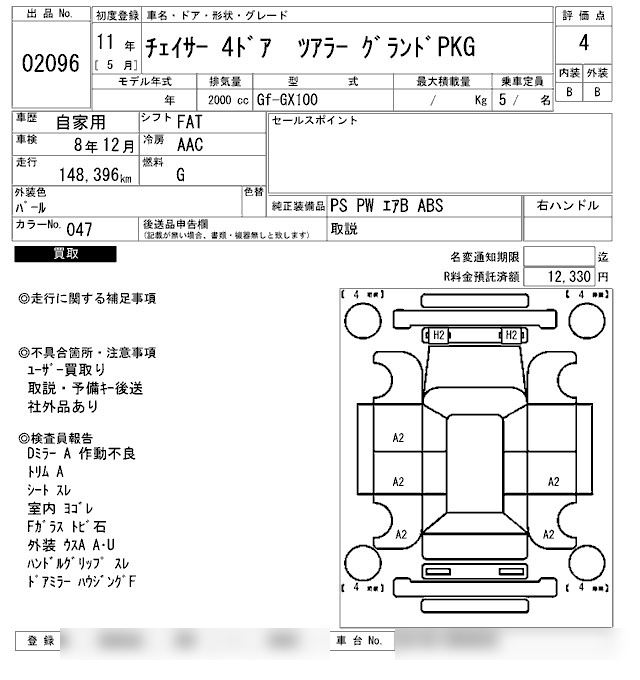
A 1999 Toyota Chaser sold through a Japanese auction. Grade 4, interior B, exterior B. Identifiers blurred.
 123456789
- Lot number. The number the car is sold under on auction day. Use it to find the lot on Unsato.
- First registration and model. Here: year 11 of the Heisei era, May, so May 1999. This is the date the car was first registered in Japan, not the model year and not the production month. Below it the inspector wrote the model name and trim: Chaser 4-door Tourer Grand Package.
- Grade, interior, exterior. The big number is the overall grade (4). The two letters under it are interior and exterior condition (B and B).
- Mileage and history. Mileage in kilometers (148,396 km here, about 92,200 miles). Above it: private use, and the date the Japanese road-worthiness inspection is valid until. A dollar sign, an asterisk or a special mark next to the mileage would mean the reading cannot be trusted.
- Engine and chassis model. Engine size (2,000 cc) and the chassis model code (GF-GX100). The code tells you the generation; the full chassis number is at the bottom.
- Equipment and steering. Factory equipment in shorthand: power steering, power windows, airbag, ABS. Transmission (floor automatic), automatic climate control, fuel type. Right-hand drive.
- Inspector notes. Three blocks on the left. Top: notes about driving (empty here). Middle: defects and warnings, the first place to look. Bottom: the inspector report with wear items. On this sheet: a door mirror that does not work properly, scratches on trim, scuffed seats, a dirty interior, a stone chip in the windshield, light scratches and a small dent on the outside, a worn steering wheel, a scuffed mirror housing, aftermarket parts fitted, owner's manual and spare key to be sent later. Translation ours, for illustration; see the note on translations below.
- Damage map. The car from above. Each code sits where the inspector found the mark: here A2 scratches on both front doors and the rear quarters, H2 marks on the front bumper. The numbers in the corners are tire condition.
- Registration and chassis number. The full chassis number (blurred here) and the registration. We check both against the export certificate when the car is collected.
Where the good and the bad are written
The left column is the inspector's voice. The middle block is the warnings: faults, odometer notes, aftermarket parts, missing keys or books. The bottom block is the wear list: scuffs, stains, chips, worn grips. Anything positive (one owner, non-smoker, service records, recent timing belt, new tires) is written in the same column or in the sales points box at the top right. The damage map on the right is the body only; mechanical condition lives in the words, never on the drawing.
We translate the notes for every lot on request and before every bid. Inspector shorthand is terse and sometimes handwritten, so any translation, ours or a machine's, can miss a nuance. Treat the translation as help, not as a guarantee: Unsato is not responsible for differences between a translation and the original sheet, and the car is sold on the original.
Letters and numbers on the car
Each mark on the map is a letter for the kind of damage and a number for its size. The scale is always 1 to 3 (small to large); S and C rust codes use 1 to 2 or 3. Where the code sits on the drawing is where the damage is on the car.
| Code | What | Sizes | What it means for you |
|---|---|---|---|
| A | Scratch | A1 small (under a thumbnail) · A2 medium (hand-sized) · A3 large (a panel-length scratch, needs paint) | Clear-coat or paint scratches. A1 and A2 polish out or are invisible from two meters; A3 is a paint job. |
| U | Dent | U1 pin or coin-sized · U2 palm-sized · U3 large | U1 is a door ding you feel more than see. U3 is a dent you notice from across the lot. |
| B | Dent with scratch | B1 · B2 · B3 | Paint is broken at the dent, so rust can start. Treat B2 and B3 as bodywork. |
| E | Dimples | E1 a few · E2 many · E3 the whole panel | Small shallow dents, typically hail or gravel. Paintless dent removal territory. |
| W | Repair / wave | W1 good, hard to see · W2 visible · W3 obvious waves, mismatched paint | The panel was painted or filled. W1 is normal on an old car; W3 hides something. |
| S | Rust | S1 light · S2 heavy | Surface rust is common at 25+ years; see the rust section below. S2 on a sill or a floor is structural money. |
| C | Corrosion | C1 · C2 · C3 (holes) | Rust that has eaten into the metal. C2 and C3 mean welding. |
| X | Needs replacement | no size | The panel or part is beyond repair in the inspector's view. |
| XX | Replaced | no size | The panel is not original. Common on bumpers and fenders; on a quarter panel it hints at an accident. |
| P | Paint faded | no size | Sun damage, usually roof, hood and trunk. |
| H | Paint deterioration | H1 · H2 | Clear coat peeling or marked paint, as on the bumper of the example sheet. |
| Y | Crack, hole or tear | Y1 · Y2 · Y3 | On bumpers, trim, lights and interior fabric. |
| G | Stone chip in glass | no size | Windshield chip. Cheap to fill, but note it for the US inspection. |
| R / RX | Glass repaired / needs replacing | no size | Only on glass; not the overall R grade. |
Rule of thumb: a few A1, A2 and U1 marks on a grade 4 car are normal and cost nothing. W marks mean paint work, which hides what was underneath. X, C or S2 anywhere on the floor or sills mean real money. A cluster of marks on one corner tells a story the grade does not.
Overall grades
| S / 6 | Nearly new: under a year old and very low mileage. Does not exist for cars old enough to import to the US. |
|---|---|
| 5 | Excellent, very light wear. Rare at 25 years and usually priced like a collector car. |
| 4.5 | Very good. A few small marks you have to look for. Strong buy. |
| 4 | Good, honest used car: some scratches and small dents, nothing structural. The most common grade worth bidding on. Not "excellent", not a show car. |
| 3.5 | Average, with visible scratches, dents, maybe some paint work or surface rust. Read below why this is often the best value on the sheet. |
| 3 | Below average. Noticeable body damage or wear; expect repairs. |
| 2 / 1 | Poor. Heavy wear, significant damage or mechanical issues. |
| R / RA | Documented accident repair. RA is minor (a replaced panel), R is more serious (frame or structural). Read the section on R cars before you dismiss one. |
| 0 / *** / dash | Not graded: sold as is, often with a mechanical fault or something the inspector would not sign off. Not automatically junk, not for a first-time buyer. |
Interior and exterior letters
| A | Very clean, like new |
|---|---|
| B | Clean, light use |
| C | Average: wear, small marks, maybe a burn or a stain |
| D | Worn: tears, stains, scratched panels, odor |
| E | Bad: needs repair or replacement |
Equipment shorthand
| AT / FAT / F5 / F6 / CAT | Automatic / floor automatic / 5-speed floor manual / 6-speed / column automatic |
|---|---|
| AC / AAC | Air conditioning / automatic climate control |
| PS · PW | Power steering · power windows |
| AB / SRS · ABS | Airbag · anti-lock brakes |
| AW | Alloy wheels |
| SR | Sunroof |
| TV · NAVI | TV · navigation |
| Leather, one owner, non-smoker, service book | Written out in Japanese in the notes when present. All of them are good signs; the service book is the best one. |
Where the value is
Grade 3.5 is often the best buy
A 3.5 usually got there for one or two visible reasons: a dented door, a faded hood, a scuffed bumper, a worn seat. The mechanical side is often identical to a grade 4 of the same model. Fix the two or three items that pulled the grade down, which is cheap compared to the auction price difference, and you own a car that looks and drives like a 4 or 4.5. Read the map and the notes to make sure the 3.5 is cosmetic and not a hidden mechanical note, then bid with confidence.
R grade is not always bad
R and RA mean the car was repaired after an accident and the auction says so. Whether that matters depends on the car and on where the damage was. A replaced front bumper and fender on a daily driver is a non-event; a repaired rear frame rail on a car you want for its originality is a different story. Japanese body repairs are, as a rule, done to a very high standard with factory panels, which is why R cars drive and look right. The price, though, is set as if they do not. If you know what you are buying and the damage location is acceptable to you, an R car is one of the better ways to save money at auction. We will tell you where the repair was before you bid.
Oil, fluids and rust: read these notes carefully
A leak note can stop the car at the port
Shipping lines refuse vehicles that drip oil, coolant, fuel or transmission fluid on the deck. If the sheet notes a leak and the car is still leaking when it reaches the export yard, it can be rejected for RoRo loading and will need repair or a container at your cost. We flag every leak note before you bid; what happens at the port is outside our control and not something we can take responsibility for.
A leak note is not always a leak
Inspectors write what they see. Oil on a valve cover can be sweating through an old gasket, a spill from the last top-up, or residue from a previous repair. The note says "oil present", not "oil dripping". Ask us to compare the wording with the photos; sometimes a rag fixes it, sometimes it is a rear main seal. The difference is in the exact words.
Rust on a 25-year-old car
A rust note on the underbody is normal at this age, and most of the time it means surface rust on suspension parts, exhaust and seams: brown, dry, cosmetic. That is expected on any car this old and is not a reason to walk away. What you want to know is whether the note says surface or structural, and where: sills, floor, strut towers and frame rails are the places that matter. Snow-country cars rust more; southern Japan cars less. We read the exact note and tell you which one you are looking at.
What people get wrong
"Grade 4 means excellent"
Grade 4 is a normal used car with marks. It is the most common grade for cars worth buying. If you expect perfection you will be disappointed; if you expect an honest 25-year-old car, grade 4 is exactly that.
The year on the sheet
Sheets show the first registration in the Japanese imperial calendar (Heisei 11 = 1999, Reiwa 2 = 2020), not the model year and not the production month. For the US 25-year rule, the month of manufacture counts. We verify it before you bid on anything close to the line.
Letters are not the grade
B/B in the header are interior and exterior letters. A grade 4 car with a C interior is normal. A grade 3.5 with A/A is unusual and worth a second look: the number usually dropped because of one thing.
Mileage marks
A dollar sign, asterisk or hash next to the mileage, or a note that the odometer was replaced, means the number cannot be verified. Treat it as unknown and price accordingly.
The map is five minutes of looking
An inspector walks around the car once, in an auction yard, often under bad light. Small items get missed, and the map records what was visible, not everything that exists.
Photos show appearance, not condition
Auction photos are for identification. A shiny car in two photos can have a rusty floor. The notes and the map matter more than the pictures.
Recycling deposit
Most sheets show a recycling fee already paid on the car (around 10,000 to 20,000 yen). It is refunded to the seller through the sale and added to the price you pay. It is not a hidden fee; it is part of every Japanese car.
"Sold as is" is literal
Auction houses accept claims only for undisclosed frame damage, odometer tampering or a wrong chassis number, and only within days of collection. Everything else is yours when the hammer falls.
A machine translation is not enough
We see it every week: a customer pastes a photo of the sheet into a chatbot, gets a fluent English paragraph, and bids on it. The paragraph reads well. It is also, regularly, wrong in exactly the places that matter. Inspectors write in shorthand and by hand; the model guesses, and guesses confidently. The accident-repair line gets turned into "repair history available" and read as a plus. "Abnormal engine noise" becomes "engine sound". "Odometer replaced" disappears. Imperial dates come out as the wrong year, and 10,000-yen units get dropped. Illegible handwriting turns into confident sentences that were never on the sheet.
Use a machine translation to get the shape of the sheet. Do not bid on it. A person who reads these sheets every day goes through the notes and the map with you before any bid, at no charge. If the inspector wrote something that changes the picture, you hear it from us, not at the port.
Five minutes before you bid
- Accident repair line: none, or R/RA. If R, ask where the repair was and decide with the price in mind.
- Mileage: no special mark next to it, and a number that fits the wear on the pedals and seats in the photos.
- Grade and letters together: 4/B/B is a normal good car; 3.5/C/D with W marks is a repaint candidate.
- The map: count the codes, look for W, X, C and S2. One or two A1/U1 are nothing; a cluster on one corner is a story.
- The notes, translated by a person: engine noise, leaks, underbody rust, odometer notes, replaced panels, missing keys or books.
- First registration vs production month: for cars near the 25-year line we verify the month before bidding.
- Total landed price at your bid, not the start price: the calculator is on every lot page.